News and Insights
What Makes a Good Environmental Impact Assessment?
Environmental Impact Assessment (EIA) is sometimes viewed primarily as a regulatory process — a series of studies, reports and approvals that must be completed before certain developments can proceed.
But a good EIA should be more than a compliance exercise.
At its best, environmental assessment is a decision-making tool. It provides an opportunity to understand environmental risk early enough for that understanding to influence project planning, design and management.
South Africa’s environmental assessment framework is established under the National Environmental Management Act (NEMA) and the EIA Regulations. The system requires potential environmental impacts associated with listed activities to be investigated and assessed before environmental authorisation is granted.
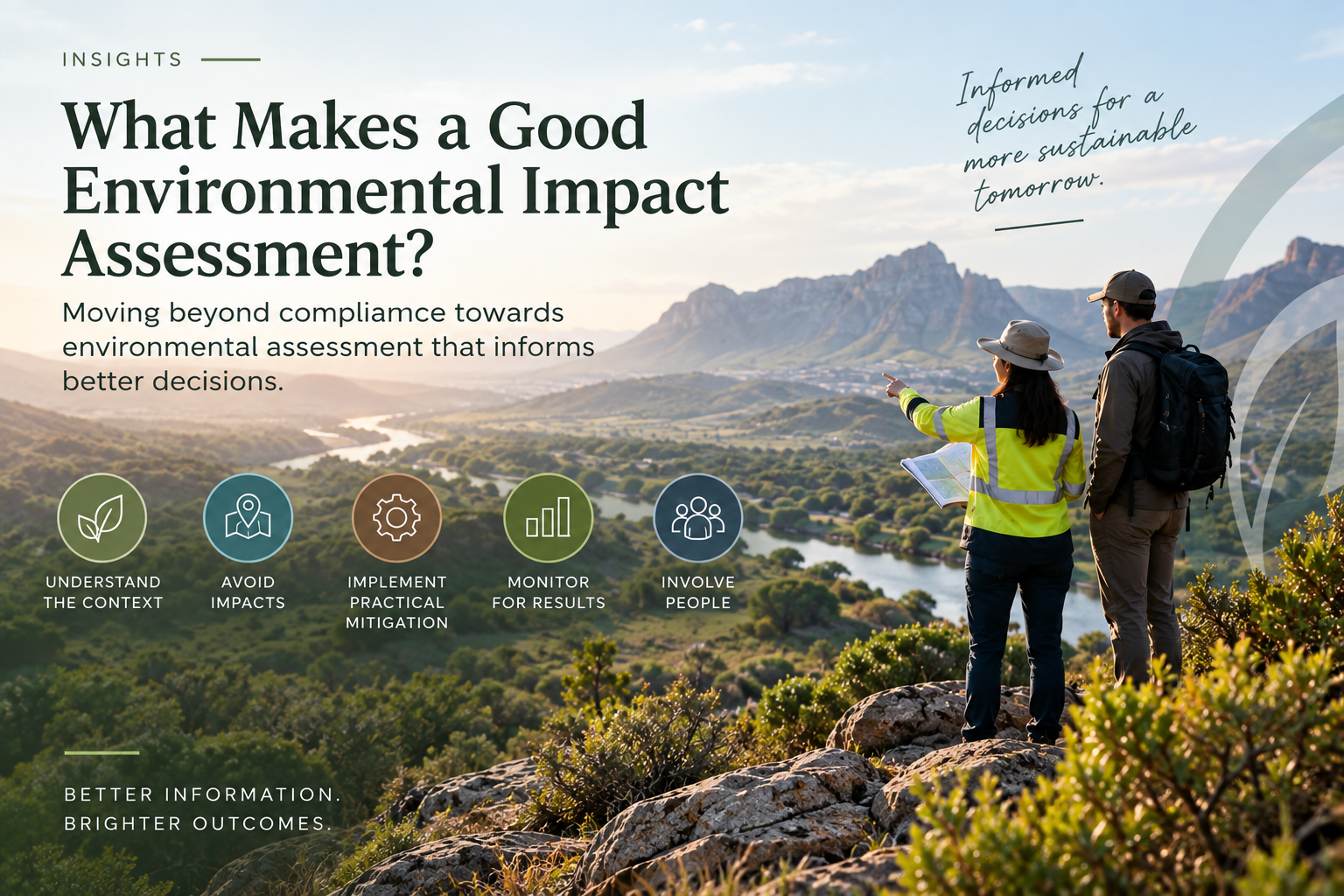
Focus on the impacts that matter
Not every environmental issue carries the same level of risk.
Effective assessment requires distinguishing between minor impacts that can be readily managed and potentially significant impacts that may influence whether, where or how a project should proceed.
This requires understanding both the proposed development and the receiving environment. The same activity undertaken in two different locations can present very different environmental risks depending on factors such as biodiversity sensitivity, water resources, existing land use and surrounding communities.
Avoid impacts before managing them
One of the greatest opportunities provided by environmental assessment occurs before project design is finalised.
Can infrastructure be repositioned to avoid a sensitive area? Can a footprint be reduced? Is there an alternative technology, layout or method that would result in less environmental disturbance?
Avoiding an impact through good planning is often more effective than trying to manage that impact later.
This is why environmental considerations are most valuable when they are incorporated early in project development, rather than introduced once key design decisions have already been made.
Make mitigation practical
Environmental reports can contain extensive lists of mitigation measures. Their value, however, ultimately depends on whether those measures can actually be implemented.
Effective mitigation should be:
specific — what action needs to be taken?
practical — can it realistically be implemented on the project?
measurable — how will we know whether it has been implemented or is working?
linked to responsibility — who needs to take action?
A technically impressive mitigation measure that cannot be implemented in practice provides little environmental benefit.
Monitoring needs a purpose
Monitoring and mitigation are related, but they are not the same thing.
Mitigation asks:
What are we going to do about the impact?
Monitoring asks:
Is our management approach working?
Useful monitoring therefore needs to go beyond collecting data. Wherever appropriate, monitoring results should be linked to thresholds or indicators that trigger investigation or management action.
A useful way of thinking about this relationship is:
Impact → Mitigation → Monitoring → Trigger → Management Response
This turns monitoring into an environmental management tool rather than simply a reporting exercise.
Consider people as part of the environmental context
Environmental decisions also affect people.
Public participation provides an important opportunity for interested and affected parties to raise concerns, contribute local knowledge and comment on potential impacts and alternatives. Public participation is an established component of South Africa’s environmental assessment framework.
Good assessment therefore combines technical environmental information with an understanding of the social and developmental context within which decisions are being made.
From compliance to better decisions
Ultimately, the value of an EIA should not be measured simply by the production of an environmental report.
Its value lies in whether environmental information has helped to:
identify material risks; avoid unnecessary impacts; improve project design; develop practical mitigation; inform decision-makers; and establish appropriate environmental management and monitoring.
When this happens, EIA moves beyond compliance and becomes what it is intended to be: a tool for informed and sustainable decision-making.
Terrasolve Environmental Solutions provides environmental assessment, environmental management and advisory services, with a focus on practical, evidence-based solutions.
A More Flexible EIA System for South Africa?
South Africa may be moving towards a significant change in the way the appropriate level of environmental assessment is determined for proposed developments.
In March 2026, the Department of Forestry, Fisheries and the Environment (DFFE), together with other government departments and provincial environmental authorities, launched national consultation on proposals for a Flexible Environmental Impact Assessment (EIA) system. Provincial consultations took place during March and April, with written submissions accepted until 31 May 2026.
The central idea is relatively straightforward: the level of environmental assessment should be more closely aligned with the actual environmental risk of a proposed development.
Why is change being considered?
South Africa’s existing regulated EIA system relies substantially on identified or “listed” activities and prescribed thresholds to determine when environmental authorisation is required and the assessment process that follows.
DFFE has identified limitations with this approach.
In particular, the Department says current triggers do not always sufficiently differentiate between the environmental sensitivities of different receiving environments. It has also identified concerns that project-level EIAs can operate within an inadequately defined strategic context, making issues such as cumulative impacts more difficult to address.
The proposed Flexible EIA system seeks to introduce greater proportionality.
What could a Flexible EIA system look like?
Under the proposal, screening would consider the nature, scale and environmental context of a proposed development to determine the appropriate level of assessment.
DFFE indicates that projects presenting significant environmental risk — particularly those within sensitive environments — would continue to undergo comprehensive EIA, including specialist studies and public participation.
Projects with low or insignificant environmental impacts could potentially follow a shorter assessment route or exit the process earlier where appropriate. Decisions would be supported by defined criteria and risk-based tools intended to maintain evidence-based, transparent and accountable decision-making.
The proposal also envisages greater use of other Integrated Environmental Management instruments, rather than relying on project-specific EIA as the primary environmental management tool in every circumstance. NEMA already provides mechanisms through which environmental management instruments can be used to streamline aspects of environmental authorisation.
Does this mean EIAs are being removed?
No.
This distinction is important.
The proposal is not simply about eliminating environmental assessment requirements. DFFE describes EIAs as a cornerstone of South Africa’s environmental management system and states that developments presenting significant environmental risks would continue to undergo comprehensive assessment.
The proposed reform is instead concerned with determining which environmental management instrument and level of assessment is appropriate to the risk involved.
At the time of writing, this should also be understood as a proposed reform, rather than treating the Flexible EIA model as the replacement regulatory system already in force.
Could a risk-based approach improve environmental assessment?
In principle, greater proportionality has some compelling advantages.
Environmental assessment resources — including specialist expertise, regulatory capacity, time and project expenditure — could be focused more intensively on developments where environmental consequences are potentially significant.
Conversely, genuinely low-risk developments may not always benefit from lengthy assessment processes simply because a predetermined activity or threshold has been triggered.
But the success of such a system would depend heavily on how environmental risk is determined.
Screening criteria would need to be sufficiently robust to identify environmental sensitivity at an early stage. Risk classification would need to be consistent and transparent, and mechanisms would need to ensure that potentially significant or cumulative impacts are not overlooked simply because an individual development initially appears relatively small.
The quality of the tools used to determine the assessment pathway may therefore become just as important as the assessment process itself.
A shift towards proportional environmental management
The Flexible EIA proposal is not emerging in isolation. DFFE links it to a longer process of EIA reform, including reviews undertaken in 2008 and 2019, the 2014 Environmental Impact Assessment and Management Strategy, and work undertaken on alternative Integrated Environmental Management instruments in 2023.
The direction of travel is therefore interesting.
Rather than asking simply:
“Does this activity trigger an EIA?”
a more flexible system could increasingly require environmental practitioners and authorities to ask:
“What is the environmental risk, and what level of assessment or environmental management instrument is appropriate to that risk?”
If implemented effectively, that could represent an important evolution in South African environmental assessment.
It will, however, be the detail of the eventual regulatory framework, screening criteria and implementation mechanisms that determines whether greater flexibility translates into more effective environmental management.
Terrasolve Environmental Solutions will continue to follow developments relating to the proposed Flexible EIA system as the reform process progresses.